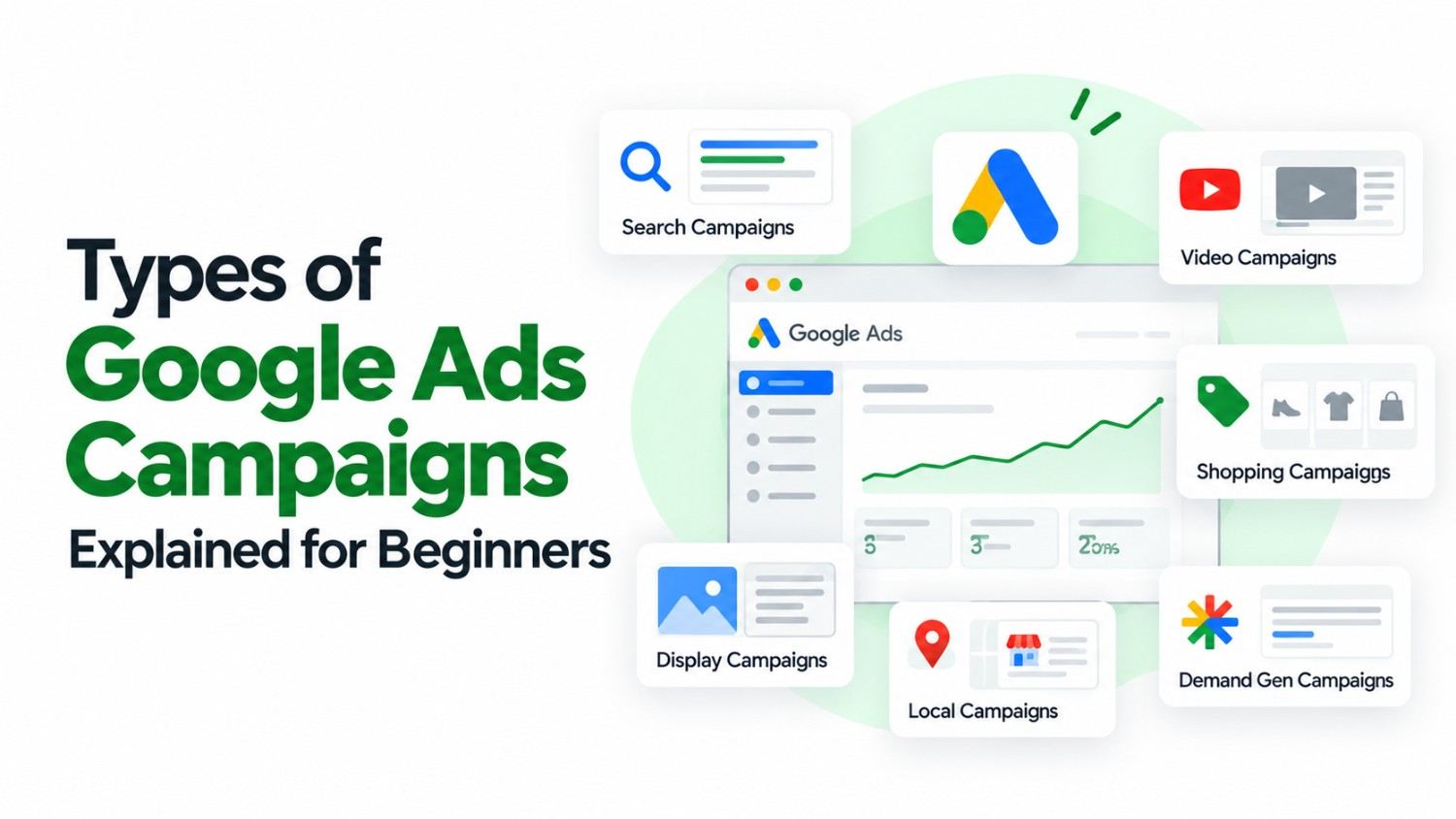
Google Ads is one of the most powerful paid advertising platforms available to businesses today. It puts your brand directly in front of people who are actively searching for what you offer - or browsing content closely related to your industry. However, one of the first things beginners discover is that Google Ads is not a single product. It is a collection of distinct campaign types, each designed to reach a different audience in a different way.
Choosing the wrong campaign type for your goal means spending money without getting meaningful results. Choosing the right one means your budget works harder from day one. This guide explains every major Google Ads campaign type in plain language, so you can make a confident, informed decision before you spend a single rupee.
What Is a Google Ads Campaign?
A campaign is the top-level structure within your Google Ads account. It is where you set your objective, budget, targeting options, and campaign type. Everything else - your ad groups, keywords, and individual ads - sits inside a campaign. Getting the campaign type right is the most important structural decision you will make, because it determines where your ads appear, who sees them, and how Google's system optimises your spending.
Google Ads offers several campaign types, each suited to a specific marketing goal. Whether you want to drive website visits, generate phone calls, sell products online, or build brand awareness, there is a campaign type built for that purpose.
Search Campaigns
Search campaigns are the most widely used campaign type and the best starting point for most beginners. When someone types a query into Google, a search campaign allows your text ad to appear at the top or bottom of the results page - right at the moment of intent.
This is what makes search campaigns uniquely effective. The person seeing your ad is not a passive browser; they have typed something specific, which means they already have a need. If you sell accounting software and someone searches "best accounting software for small business," your search ad can appear instantly, bridging the gap between their problem and your solution.
Search campaigns work on a pay-per-click model, meaning you are only charged when someone actually clicks your ad. You define which keywords should trigger your ads, write compelling headlines and descriptions, and link the ad to a relevant page on your website. For businesses with a clear service or product and an audience that already searches for it, search campaigns offer some of the highest return on ad spend of any digital channel.
Best suited for: Lead generation, direct response, service businesses, e-commerce with strong keyword demand.
Display Campaigns
While search campaigns reach people who are actively looking for something, display campaigns reach people while they are browsing other content across the internet. Google's Display Network covers millions of websites, apps, and platforms - including news sites, blogs, and Gmail. Your ads appear as visual banners, images, or responsive formats within this network.
Display advertising is particularly useful for building brand awareness and staying visible to potential customers who may not be ready to buy right now. It is also highly effective for remarketing - showing your ads specifically to people who have already visited your website. This keeps your brand in their minds as they continue browsing, nudging them back toward a purchase decision.
Because display ads interrupt rather than respond to active intent, they require stronger visual creative and compelling messaging to earn attention. The targeting options are broad but flexible, allowing you to reach audiences based on their interests, demographics, or prior interactions with your website.
Best suited for: Brand awareness, remarketing, reaching new audiences at scale, product launches.
Shopping Campaigns
Shopping campaigns are designed specifically for e-commerce businesses that sell physical products. Instead of text-based ads, shopping ads display a product image, title, price, and store name directly within Google's search results. They appear when someone searches for a product you sell, giving the user enough information to make a purchasing decision before they even visit your website.
Shopping campaigns are powered by a product feed - a structured file you submit through Google Merchant Center that contains your inventory details. Google uses this feed to match your products to relevant search queries automatically. Because of this, shopping ads tend to attract high-quality clicks from shoppers who are further along in the buying journey and closer to making a purchase.
For online retailers, shopping campaigns are often the highest-converting campaign type available. They remove friction from the discovery process and allow customers to compare products, prices, and retailers at a glance.
Best suited for: E-commerce businesses, product-based retailers, online stores with structured inventory.
Video Campaigns
Video campaigns run your video ads on YouTube and across Google's video partner network. They are a powerful format for storytelling, product demonstrations, and brand building. Video gives you the ability to show rather than tell - demonstrating how a product works, sharing a customer story, or communicating your brand's personality in a way that text and static images simply cannot.
There are several video ad formats within this campaign type. Skippable in-stream ads play before or during YouTube videos and can be skipped after five seconds, meaning you only pay when viewers watch a meaningful portion of your ad. Non-skippable ads are shorter and must be watched in full. Bumper ads are six-second non-skippable clips ideal for short, punchy brand messages.
Video campaigns work best when paired with strong creative. A poorly produced video will underperform regardless of targeting. However, when the creative is engaging and the audience targeting is precise, video campaigns can build significant brand recognition at a comparatively low cost per impression.
Best suited for: Brand building, product demonstrations, reaching audiences on YouTube, storytelling-driven businesses.
App Campaigns
App campaigns are built for businesses with a mobile application. Their goal is straightforward: drive installs of your app or re-engage users who have already downloaded it but stopped using it. What makes app campaigns distinctive is how little manual input they require. You provide a few lines of text, some images, a video if you have one, and a budget - and Google's system automatically generates ad combinations and distributes them across Search, Play Store, YouTube, and the Display Network.
Google's machine learning optimises which combinations of creative elements to show, to whom, and when, based on the likelihood of driving an install or a specific in-app action. This makes app campaigns one of the more automated campaign types available, which is useful for businesses that want results without managing granular settings.
Best suited for: Mobile app developers, SaaS businesses with a mobile product, businesses looking to grow app user base.
Performance Max Campaigns
Performance Max, often shortened to PMax, is Google's most automated and expansive campaign type. A single Performance Max campaign can show ads across all of Google's channels simultaneously - Search, Display, YouTube, Gmail, Maps, and Discover. It is goal-based, meaning you tell Google what conversion you want to drive, provide creative assets, and let the system determine where and how to show your ads for maximum results.
Performance Max uses Google's AI to test different creative combinations, identify the highest-performing audiences, and allocate budget in real time across channels. For businesses that want comprehensive coverage without managing multiple separate campaigns, PMax offers a compelling solution.
However, it requires sufficient conversion data to work effectively. Businesses that are new to Google Ads or have limited website traffic may find that PMax under-performs initially while the system gathers the data it needs to optimise. It also offers less manual control than other campaign types, which can be a drawback for advertisers who prefer visibility into what is working.
Best suited for: Businesses with established conversion tracking, those wanting full Google network coverage, scaling campaigns with proven conversion data.
Which Campaign Type Should Beginners Choose?
If you are new to Google Ads, the most practical starting point is a Search campaign. It is transparent, controllable, and directly tied to purchase intent. You can see exactly which keywords triggered your ads, monitor what you are spending, and make adjustments based on clear data. Once you have a baseline understanding of how your audience searches and which messages resonate, you can layer in additional campaign types to extend your reach.
For e-commerce businesses, Shopping campaigns should be considered alongside Search from the outset, as they are specifically designed for product discovery. For businesses focused on brand visibility rather than immediate conversions, Display or Video campaigns offer a cost-effective way to stay in front of a broad audience over time.
Conclusion
Google Ads gives businesses of every size access to one of the most intent-driven advertising systems ever built. But its effectiveness depends entirely on choosing the right campaign type for your specific goal. Search campaigns capture demand that already exists. Display and Video campaigns build awareness among audiences who may not yet know you. Shopping campaigns connect product sellers with buyers ready to make a decision. App campaigns grow your mobile user base. Performance Max covers everything at once with the power of automation.
Understanding these distinctions before you invest is the difference between a campaign that drains budget and one that consistently grows your business. Start with clarity on your goal, match it to the right campaign type, and build from there with the data your campaigns generate.
If you would like guidance selecting the right campaign type and setting up Google Ads in a way that delivers measurable returns, Bamboost's paid advertising team is ready to help.