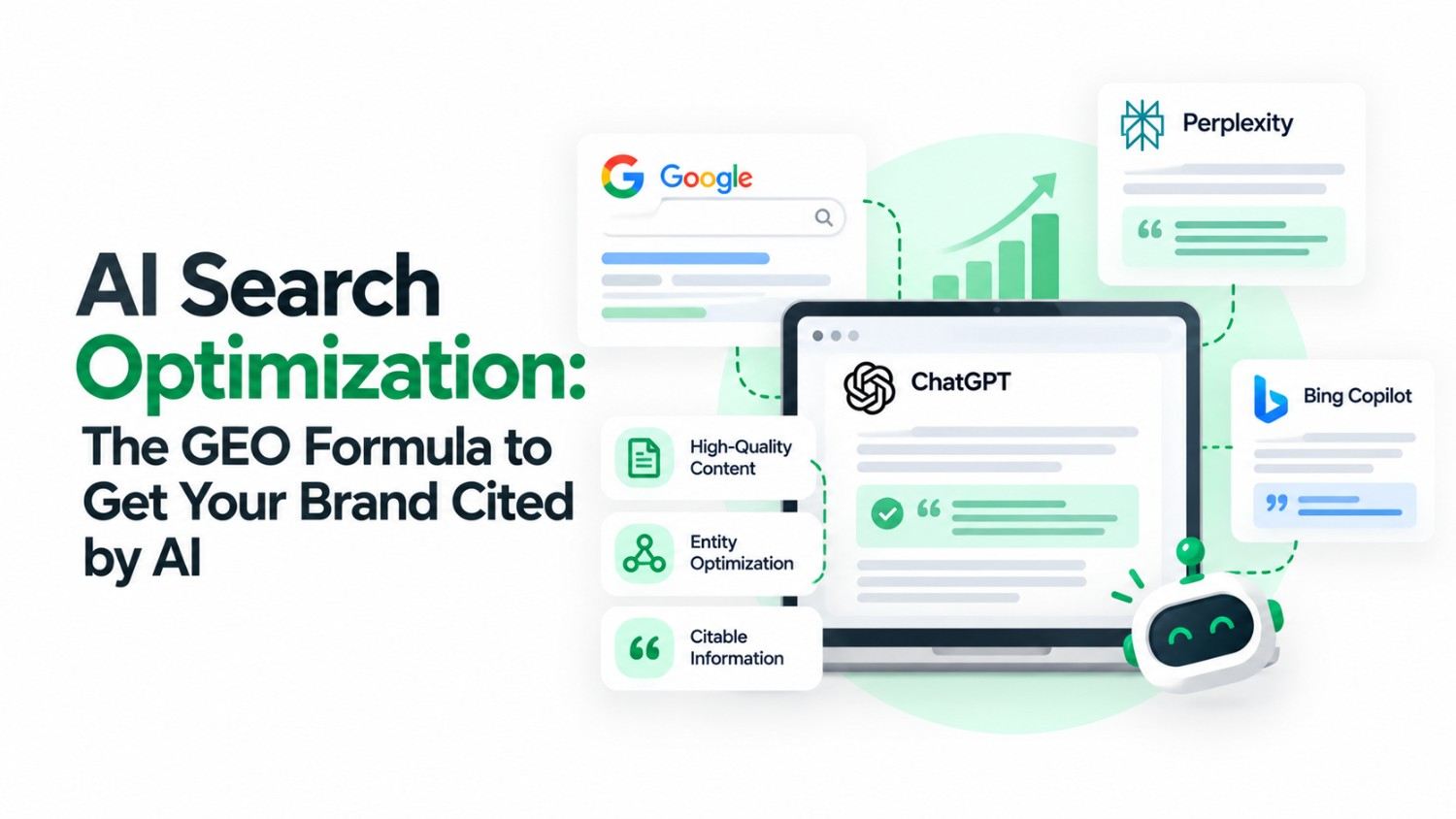
Search is evolving beyond traditional search engine results. Today, users increasingly rely on AI-powered platforms like ChatGPT, Google AI Overviews, Perplexity, Claude, and Gemini to discover information, compare products, and make decisions.
This shift has introduced a new discipline called AI Search Optimization, where the goal isn't just ranking on Google but becoming a trusted source that AI systems reference in their responses. The strategy behind this is known as Generative Engine Optimization (GEO).
If your business wants to stay visible in the AI era, understanding GEO is becoming just as important as traditional SEO.
What Is AI Search Optimization?
AI Search Optimization is the process of improving your website so AI-powered search engines and large language models can understand, trust, and reference your content.
Unlike traditional SEO, which focuses on ranking web pages, AI Search Optimization focuses on increasing the likelihood that your brand, content, or expertise is cited within AI-generated answers.
Strong AI visibility comes from publishing helpful content, building topical authority, using structured data, and demonstrating real expertise.
Why GEO Matters for ChatGPT
Generative Engine Optimization (GEO) is the practice of creating content that AI systems can easily interpret, verify, and reference.
As more users ask questions directly to AI assistants instead of typing keywords into search engines, businesses need to optimize for both humans and AI.
Benefits of GEO
- Increased AI search visibility
- Better brand recognition
- Higher authority across search platforms
- More qualified website traffic
- Greater trust among potential customers
Instead of competing only for rankings, you're competing to become a reliable source that AI engines choose to reference.
How ChatGPT Selects Sources
Many people ask: "How do I rank in ChatGPT?"
The reality is that ChatGPT doesn't rank websites like a traditional search engine. When web-enabled features are available, it generates responses by drawing on reliable, relevant, and authoritative information.
Content is more likely to be referenced when it demonstrates:
- Clear expertise on a topic
- Original and helpful information
- Strong topical authority
- Well-structured headings
- Natural language that directly answers questions
- Accurate facts supported by trustworthy sources
- Consistent brand presence across the web
This means publishing valuable content is more effective than simply repeating keywords.
Ready to Improve Your AI Search Visibility?
Our SEO specialists help businesses build AI-ready content strategies that improve visibility across Google Search, ChatGPT, Google AI Overviews, and other AI-powered search platforms.
The GEO Formula for Better AI Visibility
Businesses looking to improve AI Search Optimization should focus on a balanced strategy rather than quick wins.
1. Build Topical Authority
Publish related articles around a central topic instead of isolated blog posts. Topic clusters help AI understand your expertise.
2. Create Helpful Content
Answer real customer questions with practical, detailed guidance rather than writing only for search engines.
3. Strengthen Entity Signals
Maintain consistent business information across your website, social profiles, directories, and trusted industry platforms.
4. Use Structured Data
Implement Schema Markup to help search engines understand your content, organization, services, and authors.
5. Earn Trust
High-quality backlinks, customer reviews, digital PR, and industry mentions reinforce your credibility.
6. Keep Content Updated
AI systems prefer accurate and current information. Regularly refresh important pages with new insights and examples.
Practical GEO Checklist
Before publishing your next article, ask yourself:
- Does the content answer a real user question?
- Is the information original and useful?
- Are headings clear and descriptive?
- Is the primary topic covered in depth?
- Have you included relevant entities naturally?
- Does the page load quickly?
- Is structured data implemented?
- Does the article demonstrate expertise?
- Is the content easy for AI systems to summarize?
Following this checklist improves both search visibility and AI discoverability.
Common Mistakes to Avoid
Many websites struggle with AI visibility because they continue using outdated SEO practices.
Avoid these common mistakes:
- Publishing thin or repetitive content
- Writing only for keywords instead of users
- Ignoring technical SEO
- Creating duplicate articles
- Neglecting internal linking
- Failing to build topical authority
- Not updating outdated content
- Relying entirely on AI-generated text without human review
Quality consistently outperforms quantity in modern search.
Key Takeaways
| Traditional SEO | AI Search Optimization |
|---|---|
| Focuses on rankings | Focuses on AI citations |
| Targets search engines | Targets AI answer engines |
| Keyword driven | Context driven |
| Individual pages | Topical authority |
| Clicks | Brand visibility and trust |
Businesses that combine both approaches are better positioned for the future of search.
Conclusion
AI Search Optimization is no longer a future trend — it's becoming a core part of digital marketing. As AI-powered search continues to grow, businesses that invest in Generative Engine Optimization (GEO) will have a stronger chance of being discovered, trusted, and recommended by platforms like ChatGPT, Google AI Overviews, and Perplexity.
The best strategy remains simple: create genuinely helpful content, demonstrate expertise, build authority across the web, and keep your information accurate. When you optimize for people first and AI second, you build long-term visibility that extends beyond traditional search rankings.