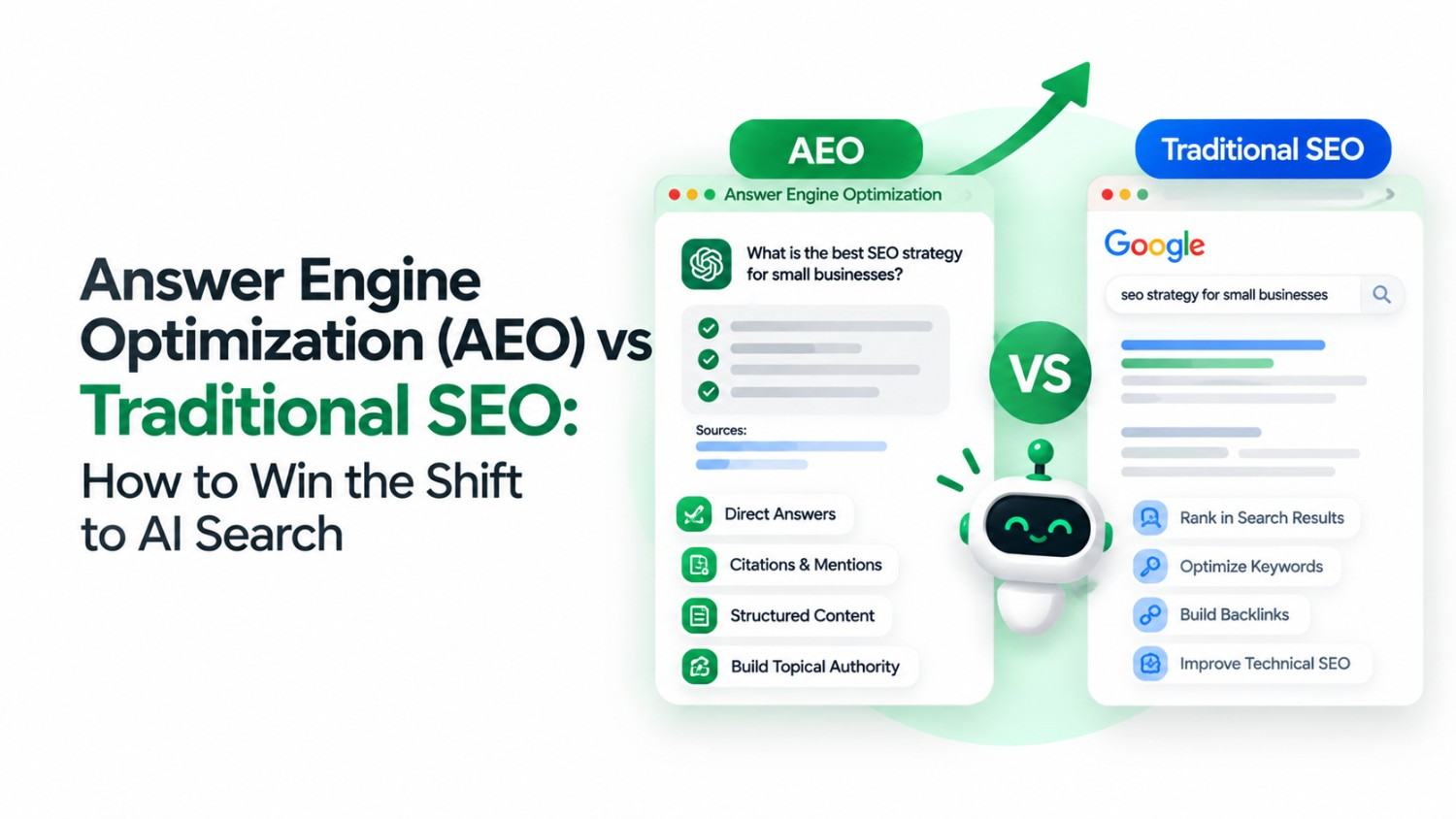
Search is changing faster than ever. People no longer just type keywords into Google - they ask AI tools like ChatGPT, Perplexity, and Google's AI Overviews direct questions and expect direct answers. This shift has given rise to a new discipline called Answer Engine Optimization (AEO), and businesses are now asking how it compares to traditional SEO.
Are they competing strategies, or do they work together? This guide breaks down the real differences and shows you how to stay visible across both search engines and AI answer engines in 2026.
What Is Traditional SEO?
Traditional SEO focuses on improving a website's visibility in search engine results pages (SERPs) like Google and Bing. It relies on ranking factors such as keywords, backlinks, page speed, site structure, and content depth. The goal is simple: earn a spot on page one so users click through to your website.
What Is Answer Engine Optimization (AEO)?
AEO is the practice of structuring content so AI-driven answer engines - such as ChatGPT, Google AI Overviews, and voice assistants - can easily understand, extract, and present it as a direct answer. Instead of optimizing purely for clicks, AEO optimizes for being quoted, summarised, or cited within an AI-generated response, often without the user ever visiting your site.
- Clear, concise answers: AEO content answers questions directly within the first few sentences.
- Structured data: Schema markup helps AI models understand context and intent.
- Conversational phrasing: Content mirrors how people naturally ask questions.
- Authority and citations: AI engines favour sources that are well-referenced and trustworthy.
Key Differences Between AEO and Traditional SEO
While both disciplines aim to increase visibility, they measure success differently and require distinct content approaches.
| Factor | Traditional SEO | AEO |
|---|---|---|
| Primary Goal | Rank on search results pages | Get cited in AI-generated answers |
| Success Metric | Clicks, rankings, traffic | Mentions, citations, visibility in AI responses |
| Content Style | Keyword-optimized, long-form | Direct, question-and-answer format |
| Key Tools | Backlinks, on-page SEO, technical SEO | Structured data, FAQs, schema markup |
| User Journey | User visits your website | User may get the answer without a click |
Search engines like Google already blend both approaches through AI Overviews built on traditional web indexing, showing that AEO doesn't replace SEO - it extends it.
Want to Rank in Both Google and AI Answers?
We build content strategies optimized for search engines and answer engines alike.
Why Your Business Needs Both
Traditional SEO builds the authority and technical foundation your site needs to be trusted. AEO builds on that foundation, packaging your content so AI answer engines can easily surface it. Ignoring either one means losing visibility in a growing part of how people search - whether that's a Google results page or a chatbot response.
How to Optimize for Both
- Keep strong technical SEO fundamentals: fast loading, mobile-friendly, secure sites
- Add FAQ sections that directly answer common customer questions
- Use schema markup so AI tools can parse your content accurately
- Write in a clear, conversational tone that mirrors natural search queries
- Continue earning quality backlinks to build the authority AI engines trust
Conclusion
AEO and traditional SEO are not rivals - they are two sides of the same visibility strategy. Traditional SEO gets you found; AEO makes sure you're understood and quoted by the AI tools shaping how people discover information today. Businesses that invest in both will be best positioned to stay visible, no matter how search continues to evolve.